Harmônicos da Ressonância Schumann: SR2 (14.3 Hz), SR3 (20.8 Hz) e Além
Beyond the famous 7.83 Hz fundamental, Earth's cavity resonates at multiple harmonic frequencies. Learn to identify SR2, SR3, and higher modes on the spectrogram.
Beyond the Fundamental
While 7.83 Hz (SR1) gets the most attention, Earth's electromagnetic cavity resonates at a series of harmonic frequencies. These harmonics are integer multiples of the fundamental, modified by the Earth's geometry and ionospheric conditions.
The Harmonic Series
| Mode | Frequency | Wavelength | Typical Amplitude | |---|---|---|---| | SR1 (n=1) | 7.83 Hz | 38,000 km | 5–15 pT | | SR2 (n=2) | 14.3 Hz | 21,000 km | 3–10 pT | | SR3 (n=3) | 20.8 Hz | 14,500 km | 2–8 pT | | SR4 (n=4) | 27.3 Hz | 11,000 km | 1–5 pT | | SR5 (n=5) | 33.8 Hz | 8,800 km | 0.5–3 pT |
Why Harmonics Matter
Each harmonic mode provides unique information about Earth's electromagnetic environment:
- SR1 — Most sensitive to global lightning activity
- SR2 — Shows stronger correlation with solar wind variations
- SR3 — Often exhibits anomalies during geomagnetic storms
- SR4 & SR5 — More influenced by local ionospheric conditions
Reading Harmonics on the Spectrogram
On the Tomsk SOS spectrogram, look for horizontal bands of increased intensity at each harmonic frequency. During high activity periods, all five modes may be clearly visible. The relative amplitudes between modes can indicate the source location of the electromagnetic excitation.
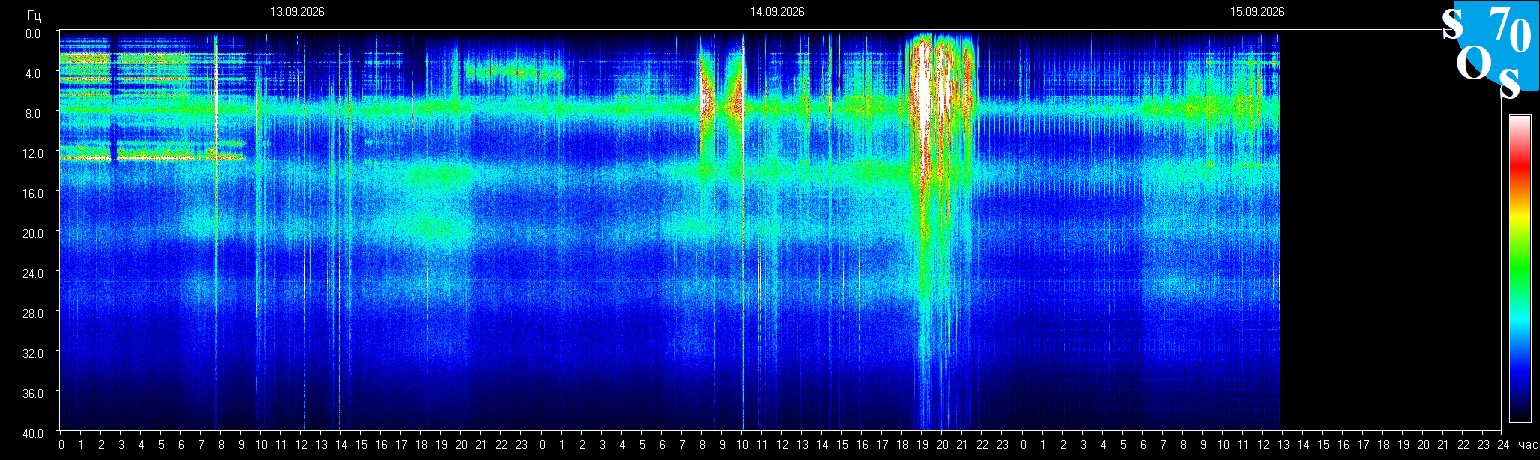
Diurnal Variations
Harmonic amplitudes vary throughout the day due to the changing ionospheric height between day and night sides of Earth. This diurnal pattern is a key signature that helps researchers distinguish genuine Schumann signals from local noise.